Blog Essay
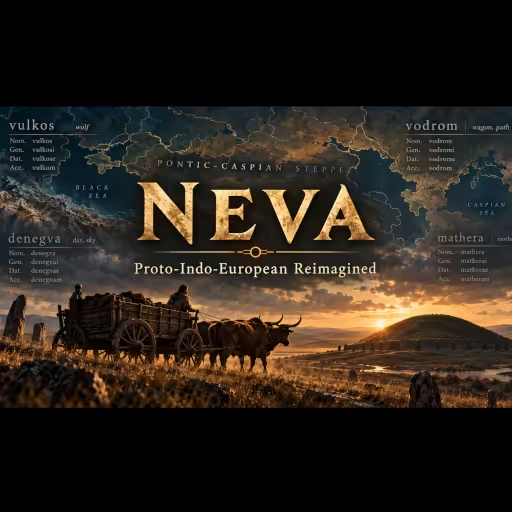
Neva: Imagining a Modern Language Born from Proto-Indo-European
Meet Neva, an open-source Proto-Indo-European-inspired constructed language, and explore its dictionary, grammar tools, and experimental translator.
Imagine a language that sounds vaguely familiar even though you’ve never heard anyone speak it. One word reminds you of Latin, another of German, and a third of an old Greek or Sanskrit form. Its nouns have cases, its verbs change with their subjects, and some words preserve the kind of ancient vowel alternations that eventually produced English pairs such as sing and sang.
Now imagine that language wasn’t found on a forgotten inscription. It was designed, deliberately, as an answer to a question:
What might a modern, relatively easy-to-learn language look like if we built it from the shared ancestry of the Indo-European family?
That’s the idea behind Neva, or Neo-Indo-European: a collaborative constructed language (sometimes called a conlang or artlang) inspired by Proto-Indo-European, the reconstructed ancestor of languages as diverse as English, Latin, Greek, Sanskrit, Persian, and many others.
The working language, its dictionary, examples, design notes, and offline Python tools are all available in the public GitHub repository:
https://github.com/basperheim/neva-neo-indo-european-language
Neva isn’t a claim to have recovered the language of some lost civilization. It’s an experiment in language design: retain enough of the Indo-European family’s historical character to make the result interesting, while simplifying the parts that would make an invented language unnecessarily difficult to speak, write, or learn.
Want to try Neva yourself? Open the interactive Neva dictionary and translator to look up words and their origins, explore noun and verb forms, see approximate IPA pronunciations, and translate selected English—Neva sentences right in your browser.
First, what is Proto-Indo-European?
Many languages that look strikingly different today belong to the same enormous family. English and German are Germanic languages; Spanish and French descend from Latin; Russian and Polish are Slavic; Hindi, Persian, Greek, Armenian, and Albanian occupy other branches of the Indo-European family.
These languages are not descended from Latin or Sanskrit as a group. Instead, their branches trace back to an older common ancestor: Proto-Indo-European, usually abbreviated PIE.
We have no surviving book, letter, or recording written in PIE itself. Linguists reconstruct aspects of it by comparing older, documented languages and identifying recurring correspondences in sounds, words, and grammatical endings.
Consider the family resemblance in words for father:
- Latin: pater
- Ancient Greek: patēr
- Sanskrit: pitṛ
- English: father
The words don’t match exactly, but their similarities are too systematic to dismiss as coincidence. When such relationships recur across thousands of words and forms, linguists can work backward toward ancestral pronunciations and structures. The resulting reconstructions are conventionally marked with an asterisk, as in PIE ph₂tḗr.
This comparative approach helped establish historical linguistics as a rigorous field. It also explains something remarkable about everyday vocabulary: the same inherited root can survive for millennia while changing its sound, spelling, and sometimes even its meaning.
For an accessible introduction to this work, the University of Texas Linguistics Research Center maintains resources on early Indo-European languages and an extensive Indo-European lexicon.
PIE matters historically because it gives us a framework for understanding how a major language family developed. Neva matters in a different way: it takes inspiration from that framework and turns it into a usable creative project. Its forms are designed, not excavated.
Why invent Neva instead of simply learning Latin or Sanskrit?
Latin, Ancient Greek, and Sanskrit already offer beautiful, sophisticated grammatical systems. But each is a historical language with its own particular development, and none represents the entire Indo-European family’s common inheritance.
A language inspired only by Latin would naturally lean toward the Romance branch. One patterned entirely on Sanskrit would inherit a very different collection of sounds and inflections. A strict attempt to reproduce reconstructed PIE would involve an even more daunting assortment of cases, verb categories, consonant clusters, vowel grades, and disputed details.
Neva takes a different route.
The goal is to build a plausible imagined relative of the Indo-European languages: something with recognizable old roots and grammatical machinery, but with the regularity expected of a consciously designed modern language.
That means making deliberate compromises:
- Preserve masculine, feminine, and neuter grammatical genders.
- Keep case endings so that a noun’s role in a sentence can be expressed directly.
- Retain a few historically inspired irregular stems rather than making every word perfectly mechanical.
- Use straightforward, largely phonetic spelling and predictable stress.
- Favor one regular verb-conjugation pattern, instead of recreating PIE’s entire verbal system.
- Build modern vocabulary through transparent word formation, without pretending prehistoric speakers had words for computers or software.
These choices make Neva feel old and new at the same time.
How Neva sounds: six vowels and no silent letters
Neva is written in the Latin alphabet. Its spelling is intended to tell you how to pronounce a word rather than forcing you to memorize the kinds of exceptions common in English.
It uses six vowels: a, e, i, o, u, y.
The first five are pronounced with fairly consistent vowel qualities. The sixth, y, represents the rounded front vowel /y/, similar to German ü in über. In other words, Neva’s y is a vowel, not the English consonant in yes.
That consonant is written j, pronounced /j/, as in the English y of yes.
Three digraphs are especially useful:
- sh sounds like sh in ship.
- th sounds like th in think.
- dh sounds like th in this.
Neva also distinguishes the familiar oi sound of boy and ai, ei, and au diphthongs. Other adjacent vowels are ordinarily pronounced separately. Thus a grammatical ending such as -osio has three vowel syllables rather than being collapsed into one complicated sound.
Stress normally falls on the second-to-last syllable. For example, patheros (“father”) is approximately pa-THE-ros, and menotrom (“computer”) is me-NO-trom.
The result is intended to be easier to read aloud than reconstructed PIE notation, which may include unfamiliar symbols such as h₁, h₂, and h₃. Those so-called laryngeals are useful to historical linguists because they help explain how ancient vowels developed; Neva generally adapts their effects rather than requiring speakers to pronounce them.
This is also where the project’s artistic side appears. A historically plausible sound shift is a starting point, but not an unbreakable law. A word can be remodeled when the alternative is awkward, confusing, or simply less appealing.
Three genders, four cases: the grammar beneath the words
One of Neva’s defining features is its noun system. Like Latin, Greek, German, and several other Indo-European languages, Neva allows noun endings to carry grammatical information.
There are three genders:
- Masculine nouns commonly end in -os.
- Feminine nouns commonly end in -a.
- Neuter nouns commonly end in -om.
Gender is a grammatical property, not necessarily a statement about biological sex. A language’s word for water can be neuter, for example, while its word for mother is feminine.
There are four cases: nominative for a typical subject, accusative for a typical direct object, genitive for possession, and dative for a recipient or indirect object.
Here is a compact look at the singular endings using vulkos (“wolf”), mathera (“mother”), and vodrom (“water”):
| Case | Wolf (masculine) | Mother (feminine) | Water (neuter) |
|---|---|---|---|
| Nominative | vulkos | mathera | vodrom |
| Accusative | vulkom | matheram | vodrom |
| Genitive | vulkosio | matheras | vodrosio |
| Dative | vulkoi | mathere | vodroi |
So vulkos is “wolf” as a subject, while vulkom is “wolf” as an object. The neuter vodrom has the same nominative and accusative form, an old Indo-European-style pattern.
Neva also distinguishes singular and plural. The masculine nominative plural of vulkos is vulkes; the feminine plural of mathera is matheras; and the neuter plural of vodrom is vodra.
These endings are intentionally streamlined. PIE had more cases and a dual number for exactly two things. Neva dispenses with that complexity while retaining enough inflection to make its ancestry recognizable.
For instance:
Mathera videth vulkom.
The mother sees a wolf.
You can tell that mathera is the subject and vulkom is the object partly from their endings. Word order normally follows the familiar subject-verb-object sequence, but the cases help make each word’s function explicit.
Neva also avoids obligatory English-style articles. There is no requirement to insert separate words meaning a or the before every noun. Context supplies the distinction.
An exception worth keeping: “foot”
A perfectly regular language can become oddly characterless. Real Indo-European languages often preserve ancient changes inside a word’s root rather than only at its ending.
Neva allows a small, explicitly listed set of such alternations. The current example is podos (“foot”). Its nominative and accusative forms use the stem pod-, but its genitive and dative use ped-: thus podos and pedosio.
That echoes the historical Indo-European phenomenon of ablaut, in which related forms show different vowel grades. It’s also a useful illustration of Neva’s guiding compromise: keep a few meaningful irregularities, but don’t require every new noun to behave unpredictably.
Verbs: familiar endings, much less memorization
Neva verbs use one regular set of personal endings. The infinitive typically ends in -en. For example, beren means “to carry.”
| Person | Neva present | English |
|---|---|---|
| I | bero | I carry |
| You (singular) | beres | You carry |
| He, she, it | bereth | Carries |
| We | beromos | We carry |
| You (plural) | berethe | You all carry |
| They | beront | They carry |
Because the verb ending already identifies the person, the subject pronoun can often be omitted. Bero vodrom means “I carry water,” even without the explicit word ego (“I”).
For ordinary verbs, Neva can form a past tense by adding e- to the verb stem. The verb kapen (“to have”) gives kapo (“I have”) and ekapo (“I had”).
A few historically inspired strong verbs instead change the stem vowel. For beren, the first-person past is boro (“I carried”). Neva doesn’t impose this on every verb; the strong verbs are a closed, documented group.
Other common constructions are deliberately straightforward:
- Vel bero vodrom. — I will carry water.
- Ne bero vodrom. — I do not carry water.
- Kapo beroto vodrom. — I have carried water.
- Jaba beres vodrom, vel kapo vodrom. — If you carry water, I will have water.
The perfect uses a form of kapen plus an invariant participle ending in -oto. It’s a regularized way to express a familiar idea without rebuilding PIE’s entire aspect system.
The project has also added simple ability and hypothetical constructions: magen (“to be able”) plus an infinitive, and vela before a present-tense verb for one sense of English “would.” These have intentionally limited meanings. English “could” in a polite request, for instance, is not automatically the same thing as past ability.
Pronouns, questions, and talking about “this” and “that”
Neva’s personal pronouns offer another glimpse of the family resemblance:
ego means “I,” ty means “you,” so means “he,” sa means “she,” tod means “it,” and vei means “we.”
Some will look familiar to anyone who has encountered Latin, Germanic languages, or other members of the family, even though the exact Neva system is newly designed.
For basic questions, ka marks a yes-or-no question:
Ka beres vodrom?
Do you carry water?
Question words include kis (“who?”), kid (“what?”), ku (“where?”), koda (“when?”), and komo (“how?”).
Neva also distinguishes between this and that. The gender-agreeing forms shos / sha / shod mean “this,” while so / sa / tod can mean “that.” A separate kinos / kina / kinom series means “which” when modifying a noun.
That gives us expressions such as shos vulkos (“this wolf”) and kinom genom (“which child?”).
More complicated sentences need relative pronouns, too. Neva uses jos / josa / jod for “who,” “which,” or “that” in relative clauses:
Vido matheram josa bereth vodrom.
I see a mother who carries water.
Here matheram is the object of “I see,” but josa is the subject of “carries water.” That relationship—agreement with a noun while taking a case from the relative clause—is another recognizably Indo-European feature.
For causal explanations, kod introduces a full “because” clause. The word jaba introduces “if” clauses. Other everyday connectors include ke (“and”), ve (“or”), and at (“but”).
Making comparisons without reinventing the grammar
Neva also has regular ways to express comparative and superlative adjectives.
Take mezos, meaning “big”:
- mezos — big
- mezoteros — bigger
- mezistos — biggest
The comparison endings, -oter- and -ist-, draw inspiration from historical Indo-European adjective formations. They are regularized for Neva, then take the ordinary gender, number, and case endings.
To say than in a simple comparison, Neva uses apo (“from”) with the accusative:
Shos vulkos est mezoteros apo som eshvom.
This wolf is bigger than that horse.
This use of apo is a Neva convention; it isn’t being presented as a word-for-word reproduction of ancient PIE syntax.
Creating words for a world PIE never knew
Perhaps the most interesting part of a modernized ancestral language is what happens when it needs modern vocabulary.
Reconstructed PIE can provide useful roots for water, carrying, thinking, animals, family members, and basic actions. It cannot give us attested prehistoric names for computers, electric lamps, or modern kitchen appliances.
Rather than borrow every new word from English, Neva can form compounds and derivatives.
The productive ending -otrom creates a neuter instrument noun. From a root associated with thinking, Neva forms menotrom, literally a “thinking instrument”: a computer.
Other productive patterns include -otoros for a masculine agent, -otia for a feminine action noun, and -itia for a feminine quality noun. Gerbotoros, for example, can mean “writer”; nevitia is “newness.”
The language also has ordinary vocabulary such as shvonos (“dog”), eshvos (“horse”), ovisa (“sheep”), sedotrom (“chair”), and temom (“time”).
One particularly satisfying word is denegva, which can mean either “tongue” or “language.” The semantic connection is familiar from Latin lingua, which has both meanings. Neva preserves that natural idea without needing two unrelated words for the same conceptual family.
Not every form in the dictionary is equally ancient in inspiration. Some rest on well-established reconstructed roots. Others are remodeled from later Indo-European branches; still others are transparent modern inventions. A cat word such as miava, for example, is an onomatopoeic Neva coinage—not a claim that PIE speakers called cats that.
The growing lexicon contains more than 850 headwords, including base words, compounds, derived forms, and grammatical particles. That does not mean each entry is an independently verified PIE reconstruction. Historical evidence and uncertainty are tracked in the public CSV and design notes, and vocabulary continues to evolve.
What can you actually say in Neva?
Even a small language comes alive when you can exchange a greeting or tell a tiny story.
A basic conversation might begin:
Vese! — Hello!
Komo es? — How are you?
Em vese. — I am well.
Vesom deinom! — Good day!
Or consider this brief scene from the project’s beginner material:
Vulkos videth eshvom.
The wolf sees a horse.
Eshvos videth vulkom.
The horse sees a wolf.
Shos vulkos est mezoteros apo som eshvom.
This wolf is bigger than that horse.
Jaba eshvos videth vulkom, eshvos ieth ad domom.
If the horse sees a wolf, the horse goes toward the home.
Nobody is claiming this is an ancient folk tale. The point is that a small, consistent grammar is already enough to combine recognizable words into a scene with subjects, objects, comparison, and a conditional.
That is the next practical challenge: not just increasing the dictionary’s size, but making Neva expressive enough for conversations, directions, anecdotes, and eventually short fables.
The open-source Python tools
Neva isn’t only a document listing invented words. The GitHub project includes a small suite of offline Python 3.10+ scripts for exploring and testing the language. The core CLI uses the Python standard library, so there’s no hosted translation service to sign up for.
After cloning the repository, you can run commands from its root:
git clone https://github.com/basperheim/neva-neo-indo-european-language.git
cd neva-neo-indo-european-language

# Look up a word
python3 scripts/neva.py lookup water

# Decline a noun into its accusative singular
python3 scripts/neva.py decline vulkos M --case accusative

# Make a feminine comparative adjective
python3 scripts/neva.py compare mezos --degree comparative --gender F

# Try a simple Neva-to-English sentence
python3 scripts/neva.py translate "Kapo beroto vodrom."

# Translate a simple English sentence into Neva
python3 scripts/neva.py translate --from en --to neva "I see this wolf."

# Translate one dictionary word
python3 scripts/neva.py translate --from en --to neva language

# Get an approximate IPA transcription
python3 scripts/neva.py ipa "Kapo beroto vodrom."

# Browse short example conversations and stories
python3 scripts/neva.py examples --category Story
The translator is intentionally limited and deterministic. It handles selected grammatical patterns and known vocabulary; it is not a general-purpose English-to-Neva AI translator. Unsupported input is preserved with a warning, or explicitly rejected when you add --strict.
The repository also includes a bilingual sentence corpus, tests for inflection and translation behavior, an English-frequency vocabulary audit, and extensive documentation explaining which linguistic decisions are settled and which are still provisional.
You can also use the language tools directly on ChapterGuides: the Neva Dictionary & Translator offers searchable entries with etymological provenance, noun declension, verb conjugation, IPA pronunciation, and a bounded English ↔ Neva translator. The Go-powered web tools load validated vocabulary and shared lexical data from the public Neva repository on a schedule, so dictionary updates do not require a new website deployment. The Python reference implementation supports additional grammatical constructions not yet available on the website.
An experiment in what languages inherit—and what they choose
A natural language is the product of generations of speakers, migration, contact, chance, and countless small changes. A constructed language begins with conscious decisions. Neva’s challenge is to make those decisions feel coherent rather than arbitrary.
Its historical inspiration is real. Proto-Indo-European reconstruction helps explain why words and grammatical structures recur across languages separated by enormous distances and centuries of change. Neva borrows ideas from that shared inheritance: endings, roots, vowel grades, gender, and the ability to create new words from older material.
But Neva is not historically significant as a newly discovered ancient language, nor is it an attempt to replace the work of comparative linguists. Its value is educational and creative. It lets us ask what is essential to the character of an Indo-European language, what complexity can be discarded, and how far inherited patterns can be extended into a modern vocabulary.
A project like this also makes etymology less abstract. Instead of reading that a root produced distant descendants, you have to decide how a word should sound, how it should decline, whether its gender is justified, and what to do when an ancient idea needs a modern meaning.
That process can make the shared history of English, Latin, Greek, Sanskrit, Germanic, Slavic, and other Indo-European languages feel less like a chart in a textbook and more like a living set of possibilities.
Neva remains a work in progress, which is part of the appeal. Its grammar is substantial enough to experiment with, but open enough to keep refining.
Try Neva online: Explore the dictionary, grammar, and translator
Explore the open-source language specification, code, and design history:
https://github.com/basperheim/neva-neo-indo-european-language