Blog Essay
Old English Beginners Learning Guide
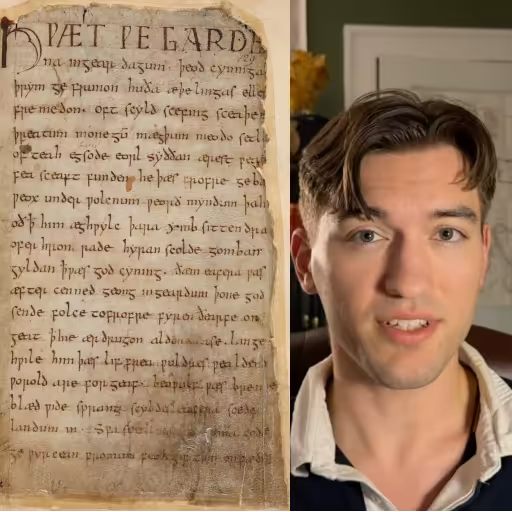
A summary of how to learn Old English for beginners by Graham Scheper.
The useful part of Scheper’s video is that he gives you an actual learning sequence, rather than dumping a pile of grammars and dictionaries on you.
His basic philosophy is: start reading immediately, reread aggressively, learn grammar alongside the reading, and gradually replace learner material with authentic Old English. He treats reading fluency—not conversational ability or perfect pronunciation—as the main goal.
What Scheper recommends
First, pick a reason for learning Old English and preferably a target text. He divides interests loosely into linguistic/history-of-English interests versus literary interests, although he argues that the two ultimately can’t be separated. If you’re interested in literature, he suggests initially gravitating toward either religious/prose material or heroic/poetic material because each develops its own recurring vocabulary.
For a beginner, though, don’t start by trying to brute-force Beowulf. His recommended progression is roughly:
-
Learn enough pronunciation to read aloud, but don’t obsess over it. He explicitly says reading a lot with imperfect pronunciation is better than reading nothing because you’re trying to perfect every vowel.
-
Start reading Ōsweald Bera, Colin Gorrie’s graded Old English reader, and/or the free Old English Aerobics annotated texts.
-
Use his three-reading method:
- First pass: read without looking anything up. Just figure out what you can.
- Second pass: look up vocabulary/grammar and annotate the text.
- Third pass: read relatively quickly for meaning and enjoyment.
-
At the same time, work slowly through an actual grammar—preferably R. D. Fulk, with Peter Baker as another good choice.
-
Reread constantly. He considers this one of the most important techniques for a corpus/dead language because repeated exposure causes vocabulary and constructions to become automatic.
-
Once the graded reader starts approaching ordinary prose difficulty—he puts this around chapter 10 of Ōsweald Bera—start reading a sustained authentic prose work rather than random snippets.
-
Prefer an edition with a facing-page Modern English translation, because you can check an expert translation immediately instead of constantly breaking your reading flow to search dictionaries.
-
Finish your grammar, then shift increasingly toward sheer reading volume.
-
Once ordinary prose doesn’t feel terrifying anymore, start poetry: The Wanderer, Battle of Maldon, Deor, religious poetry, and eventually Beowulf.
He loosely suggests that someone working consistently might reach the point of tackling Beowulf after roughly 50 hours of study, but he’s clearly presenting that as a ballpark rather than a magic number.
One point he emphasizes pretty strongly: do not rely on “Old English translators,” Old English Wikipedia, or AI-generated Old English. His argument is that the surviving corpus is comparatively small and there’s a lot of bad Neo-Old-English material online contaminating what beginners encounter. That’s Scheper’s assessment, but it’s a reasonable reason to use scholarly corpora/dictionaries as the authority when checking OE.
Links/resources mentioned in the video
Here’s the useful part to bookmark.
Start here — pronunciation and beginner reading
-
Graham Scheper — How to Learn Old English: complete guide for beginners Watch the video
-
Graham Scheper’s YouTube channel Graham Scheper on YouTube
-
Colin Gorrie — beginner Old English pronunciation video — this is the pronunciation video Scheper tells you to watch first. Colin also has an excellent collection of OE resources. (Dead Language Society) Colin Gorrie’s Old English pronunciation video Colin Gorrie’s Old English resource hub
-
Simon Roper — Old English Pronunciation: A Comprehensive Reconstruction — much deeper; 2½+ hours. This is excellent once you actually care about the phonetic details. (YouTube)
Old English Pronunciation: A Comprehensive Reconstruction
-
Ōsweald Bera — Colin Gorrie’s graded Old English reader. It begins with deliberately tiny vocabulary and simple syntax and progressively approaches authentic OE prose. (Colin Gorrie) Ōsweald Bera
-
Old English Aerobics — probably the most useful completely free beginner resource he mentions. It contains annotated authentic texts where you can click words for definitions and grammatical information. The anthology includes Genesis 3, Ælfric’s Life of St Æthelthryth, Cynewulf and Cyneheard, Alfred’s Pastoral Care preface, Cædmon, etc. (Old English Aerobics) Old English Aerobics Anthology
Grammars
-
R. D. Fulk — An Introductory Grammar of Old English with an Anthology of Readings — Scheper’s preferred grammar. This is the corrected open-access edition, legally available free from Indiana University. (IUScholarWorks) Free Fulk grammar — Indiana University
-
Peter S. Baker — Introduction to Old English, 3rd ed. — his preferred physical-book alternative. It’s explicitly designed for readers without previous training in traditional grammar. (Wiley Store) Peter Baker — Introduction to Old English
-
Bruce Mitchell & Fred C. Robinson — A Guide to Old English, 8th ed. — another option if Fulk/Baker doesn’t click with you. Scheper says he’s personally not a huge fan, but acknowledges that it’s extremely popular. It includes grammar plus an anthology and glossary. (Wiley-VCH) A Guide to Old English — Wiley
-
Henry Sweet — Sweet’s Anglo-Saxon Primer — the old-school option Scheper mentions, noting its association with Tolkien’s teaching. Older editions are freely borrowable/readable online. (Open Library) Sweet’s Anglo-Saxon Primer — Open Library / Internet Archive
Dictionaries
-
Wiktionary — Scheper actually recommends it for beginners, especially because you can often search an inflected form and have Wiktionary identify the lemma and morphology for you. That’s enormously convenient before you’ve internalized OE declensions and conjugations. Old English on Wiktionary
-
Bosworth—Toller Anglo-Saxon Dictionary Online — the big free historical dictionary. Much deeper than Wiktionary, with meanings and attestations from texts, although its antiquated conventions and Latin can make it less friendly to beginners. (Bosworth-Toller’s Dictionary) Bosworth—Toller Online
-
A Thesaurus of Old English — University of Glasgow — especially useful if you want to compose Old English or investigate semantic fields rather than simply decode a text. It organizes vocabulary by concepts/meaning. (Old English Thesaurus) A Thesaurus of Old English
-
Dictionary of Old English — University of Toronto — the scholarly heavy artillery. Scheper considers it the best dictionary, but notes that it is incomplete and paid, making it more useful for advanced study/research than for a beginner. The current DOE project is built from a corpus containing at least one copy of each surviving Old English text. (DHN University of Toronto) Dictionary of Old English
Community
-
Old English Discord — Scheper specifically recommends it because there are serious students, teachers and knowledgeable hobbyists there, including people interested in dialects and composing/speaking OE. The r/OldEnglish community currently lists it as its partner Discord. (Reddit) Join the Old English Discord
-
r/OldEnglish — useful partly because the Discord/community resource lists tend to turn up there. r/OldEnglish
Authentic texts / facing-page editions
-
Dumbarton Oaks Medieval Library — Old English collection — this is Scheper’s main recommendation once you’re leaving beginner exercises behind. Their editions give you the OE and a facing-page English translation, which is exactly the format he wants you using. Their catalogue now includes Ælfric, the Old English Chronicle, poetry, Boethius and others. (Dumbarton Oaks Medieval Library) Dumbarton Oaks Old English volumes
-
Old English Poems of Christ and His Saints — specifically mentioned as a good way into religious poetry; includes Andreas, The Vision of the Cross/Dream of the Rood, Guthlac A, etc. (Dumbarton Oaks Medieval Library) Old English Poems of Christ and His Saints
-
Eight Old English Poems, ed. R. D. Fulk — one of Scheper’s strongest recommendations for shorter heroic/contemplative poetry. It contains Cædmon’s Hymn, Battle of Brunanburh, Dream of the Rood, Battle of Maldon, Wanderer, Seafarer, Deor, and The Wife’s Lament. (Department of English) Eight Old English Poems — Indiana University description
Beowulf
For Beowulf, Scheper essentially gives you two levels:
Student-friendly: Tom Shippey’s Beowulf: Translation and Commentary, edited by Leonard Neidorf. It has Old English opposite the translation plus extensive commentary—very close to the ideal setup he describes. (Uppsala Books) Shippey & Neidorf — Beowulf: Translation and Commentary
Scholarly: Klaeber’s Beowulf and the Fight at Finnsburg, 4th ed., edited by R. D. Fulk, Robert Bjork and John Niles. No facing translation; instead you get the critical OE text, huge introduction, glossary and enormous scholarly commentary. (University of Toronto Press Distribution) Klaeber’s Beowulf — University of Toronto Press
If I compressed Scheper’s whole video into one curriculum
I’d boil it down to:
Colin Gorrie pronunciation → Ōsweald Bera + Old English Aerobics → Fulk grammar alongside them → Wiktionary initially → Bosworth-Toller as you improve → reread everything repeatedly → sustained authentic prose with a facing translation → poetry → Beowulf.
And the part I’d take most seriously is the rereading. It’s easy to fall into the trap of constantly collecting new vocabulary and grammar while never developing automatic recognition. His three-pass system attacks exactly that problem.
For someone interested in the actual history/etymology of English, rather than merely being able to say you translated Beowulf, Fulk + Old English Aerobics + Bosworth-Toller is an absurdly good free starting stack. You could spend months with those three without needing to buy anything.