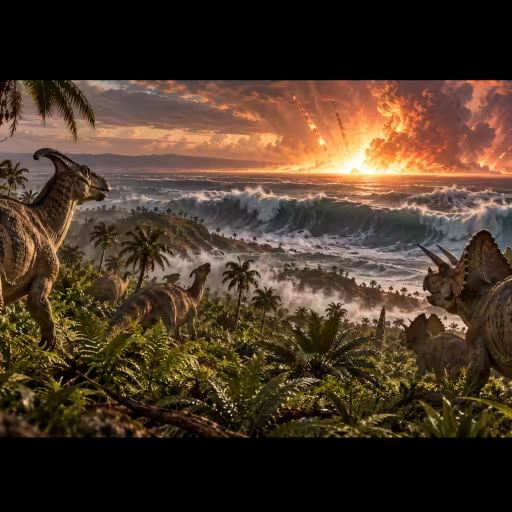
Blog Essay
The Asteroid that Killed the Dinosaurs
Review of a video by Nick Longrich that explains where the asteroid that killed the dinosaurs came from.
The Asteroid that Killed the Dinosaurs: What Nick Longrich gets right, wrong, and what we actually know
Where did the Chicxulub asteroid come from?
The best-supported explanation involves two different locations:
- Original formation: Probably beyond Jupiter’s orbit, approximately 4.56 billion years ago.
- More recent home: Likely the outer portion of the main asteroid belt, between Mars and Jupiter, before its orbit became unstable.
A 2024 study published in Science analyzed ruthenium isotopes in the sediment layer left by the impact. The chemical evidence strongly indicates that the object was a carbonaceous-type asteroid whose material originally formed beyond Jupiter.
A separate 2021 study published in Icarus used orbital simulations to estimate that the impactor had approximately a 60% probability of coming from the main asteroid belt beyond 2.5 astronomical units from the Sun.
So the likely history is something like this:
- 4.56 billion years ago: Primitive carbonaceous material forms in the outer solar system, beyond Jupiter.
- Early solar-system history: Gravitational interactions involving the giant planets redistribute some of that material into the asteroid belt.
- Billions of years pass: The asteroid, or a larger parent body from which it eventually broke off, orbits the Sun.
- Sometime before 66 million years ago: Orbital disturbances push the impactor onto a trajectory that crosses the inner solar system.
- 66 million years ago: It collides with Earth near what is now Mexico’s Yucatán Peninsula.
The chemical identification is strongly supported. The specific sequence of orbital changes is a plausible reconstruction, not something we can directly verify.
But isn’t Jupiter supposed to protect Earth?
Here’s the misconception: Jupiter doesn’t automatically capture everything its gravity attracts.
Gravity isn’t a vacuum cleaner.
An asteroid approaching Jupiter will accelerate toward it, but unless the asteroid actually collides with Jupiter or loses sufficient energy through some interaction, it can simply swing around and continue traveling.
And here’s the important part: Jupiter can change the asteroid’s velocity relative to the Sun.
Depending on the geometry of the encounter, Jupiter can:
- Throw the object out of the solar system.
- Redirect it into a different orbit.
- Push it toward the inner solar system.
- Occasionally capture it or cause a collision.
NASA deliberately exploits the same gravitational-slingshot physics to accelerate spacecraft, including the Voyager missions. NASA explains the mechanics here.
Jupiter can actually increase Earth’s asteroid impact risk
In 2010, astronomers Jonti Horner and Barrie Jones published a study examining whether Jupiter protects Earth from impacts.
Their results challenged the familiar protective-Jupiter explanation.
They found that Jupiter tends to reduce the threat from long-period comets but can increase the number of asteroids entering Earth-crossing orbits.
In their simulations, a Jupiter-mass planet could actually increase the asteroid impact rate compared with a system having virtually no Jupiter.
That doesn’t mean Jupiter is universally dangerous. The net effect depends on the population of objects, planetary architecture, and assumptions of the simulation.
But it does demonstrate that Jupiter’s influence is more complicated than simply catching dangerous objects.
Source: Jupiter: Friend or Foe? An Answer — Astronomy & Geophysics (2010).
Here’s how Jupiter might have sent Chicxulub toward Earth
This is the part Longrich discusses that connects directly to the question.
Jupiter doesn’t even have to get particularly close to an asteroid to destabilize its orbit.
It can do so through something called orbital resonance.
Imagine an asteroid orbiting the Sun three times for every one orbit Jupiter completes.
That’s a 3:1 orbital resonance.
Every few orbits, Jupiter’s gravitational influence produces a small perturbation on the asteroid.
These perturbations can accumulate over millions of years, changing the asteroid’s orbital eccentricity.
Eventually, its orbit may become elongated enough to cross the paths of Mars or Earth.
Distribution of asteroids showing gaps caused by gravitational resonances with Jupiter
The Kirkwood gaps in the asteroid belt. Notice the large gaps at orbital resonances such as 3:1 and 2:1 with Jupiter. These are regions where Jupiter’s repeated gravitational perturbations destabilize many asteroid orbits.
These gaps are observable evidence that Jupiter has been clearing particular orbital regions over time.
Longrich also discusses the Yarkovsky effect, in which asymmetric thermal radiation gradually changes an asteroid’s orbit. This effect can help deliver asteroids into resonances, although it operates much more slowly on large objects than on small ones. Collisions and other gravitational processes are also important.
The crucial point is that Jupiter can destabilize an asteroid’s orbit without physically encountering it.
An asteroid might spend billions of years in the belt, gradually enter an unstable region, and eventually become an Earth-crossing object.
So Jupiter doesn’t necessarily intercept the asteroid. In some situations, Jupiter is the reason it becomes a threat.
1. My overall assessment of the video
I think Nick Longrich makes a compelling argument, and much of his underlying science is sound. But I’d separate his presentation into three categories:
- Well-established science: The Chicxulub impact, its role in the extinction of the dinosaurs, the evidence for an enormous tsunami, and the identification of the impactor as a carbonaceous asteroid.
- Plausible but incompletely understood science: The precise extinction mechanisms, the significance of where the asteroid struck, how the atmosphere responded, and the evolutionary consequences.
- Speculation: His estimates of astronomical improbability, the idea that the impact was almost perfectly designed to eliminate dinosaurs while sparing mammals, and his philosophical suggestions about God or simulation theory.
The most interesting idea he raises is that the asteroid’s size alone may not explain the extinction. Where it struck could have been extraordinarily important.
An identical asteroid striking a different region of Earth might have produced substantially different consequences.
That’s a legitimate scientific possibility, supported by published research.
However, I think he occasionally exaggerates the improbability of the event and uses that improbability to suggest something almost supernatural. That’s where I disagree most strongly.
There are also a few factual mistakes or misleading numbers in the video.
For example:
- He repeatedly suggests that 90—95% of all species went extinct. The generally accepted estimate is approximately 75% of species. That’s still one of the largest mass extinctions in Earth’s history.
- He describes the impact as releasing approximately 100 billion megatons of TNT. That’s roughly 1,000 times higher than commonly cited estimates of around 100 million megatons. The latter is consistent with estimates from the Lunar and Planetary Institute.
- His explanation of early Earth’s water and organic chemistry is interesting but more speculative than he acknowledges. I’ll return to that.
Those issues aside, I think the video’s strongest material is its discussion of the actual geological evidence.
2. How enormous were the Chicxulub tsunamis?
This is one of the most fascinating parts of the entire event.
Yes, tsunamis hundreds or even thousands of meters high are physically plausible near the impact, and the geological record contains evidence that enormous waves actually occurred.
The important distinction is between the initial disturbance near the crater, tsunami heights in the open ocean, and the heights of waves as they reached coastlines.
A particularly useful study was published in 2022:
The Chicxulub Impact Produced a Powerful Global Tsunami — Range et al., AGU Advances (2022)
Researchers simulated the initial impact and then modeled how the resulting tsunami propagated through Earth’s oceans as they existed 66 million years ago.
Their results are extraordinary.
How high were the waves?
| Location or stage | Estimated wave height |
|---|---|
| Initial ejecta-generated water displacement, about 2.5 minutes after impact | Up to 4,500 meters (14,800 feet) |
| Outgoing tsunami approximately 10 minutes after impact | About 1,500 meters (4,900 feet) |
| Open waters of the Gulf of Mexico | Generally over 100 meters (330 feet) |
| Parts of the North Atlantic | Over 10 meters (33 feet) offshore |
| Many other distant coastlines | Offshore amplitudes exceeding 1–10 meters |
The 4.5-kilometer figure describes an extraordinary, short-lived displacement generated by the impact and falling ejecta. It wasn’t a conventional tsunami that traveled across the ocean at that height.
Likewise, the 1.5-kilometer wave was still relatively close to the impact site.
The waves diminished dramatically as they spread, although shallow coastal waters could amplify them again.
Modeled maximum tsunami amplitudes across the world’s ancient oceans following the Chicxulub impact
Modeled maximum tsunami amplitudes in meters. Ancient continental geography is shown in gray, with modern coastlines superimposed. Source: Physics Today, based on the global Chicxulub tsunami modeling research.
The researchers estimated that the tsunami carried up to 30,000 times the energy of the 2004 Indian Ocean tsunami, which killed approximately 230,000 people.
The models suggest tsunami waves reached much of the world’s coastline within approximately 48 hours.
One limitation: the global simulations do not resolve detailed coastal flooding or maximum inland run-up. Therefore, we cannot confidently say exactly how tall the waves became at every shoreline or how far inland they penetrated.
Can we still see evidence of tsunami damage after 66 million years?
Absolutely. And this is where the science gets especially interesting.
We don’t find recognizable remains of flattened forests or damaged buildings, obviously. What we find are geological structures that violent water movement left behind.
Evidence #1: Giant underwater ripples buried beneath Louisiana
In 2021, researchers published an investigation of enormous sediment ripples found approximately 1,500 meters (4,900 feet) beneath Louisiana.
These were discovered using seismic data originally collected by the petroleum industry.
The researchers identified structures with:
- Average wavelengths of approximately 600 meters (2,000 feet).
- Average ripple heights of approximately 16 meters (52 feet).
- A position in the sedimentary record corresponding to the Chicxulub impact.
These are essentially gigantic underwater sediment ripples, interpreted as having formed when the tsunami swept across the ancient seafloor.
Importantly, the 16-meter measurement is the height of the sediment ripples, not the height of the tsunami itself.
Think about how moving water forms little ripples on a sandy beach. Now imagine the same general sediment-transport process operating on an enormously larger scale.
The structures are buried under thousands of feet of subsequently deposited sediment, yet their shapes remain detectable.
Source: Chicxulub impact tsunami megaripples in the subsurface of Louisiana (2021).
Evidence #2: The actual crater contains deposits from the first day after impact
This might be my favorite piece of evidence.
In 2019, researchers published results from drilling directly into the Chicxulub crater.
They recovered a sequence approximately 130 meters (427 feet) thick, interpreted as having accumulated during the first day following the asteroid impact.
The evidence suggests an extraordinary sequence:
- The asteroid strikes, excavating the enormous crater.
- The surrounding crust rebounds, forming a ring of uplifted rock.
- Melted rock and shattered debris accumulate.
- Ocean water rushes back into the enormous cavity.
- Powerful currents and waves redistribute material.
- A returning tsunami deposits additional sediment and debris, including charcoal associated with fires on land.
In other words, we have what amounts to a geological record of some of the first hours after the dinosaurs’ extinction event began.
That’s remarkable preservation.
Source: The First Day of the Cenozoic — PNAS (2019).
Evidence #3: Sediments across the Gulf of Mexico
Geologists have also identified widespread disturbed sedimentary deposits throughout the Gulf of Mexico.
These include evidence of underwater landslides, redistributed coastal material, disrupted seafloor sediments, and exceptionally thick deposits.
A 2016 study estimated that approximately 198,000 cubic kilometers of sediment were redistributed across the Gulf basin through impact-related processes.
Not all of that material was transported directly by tsunami waves. Powerful earthquake-induced underwater landslides and sediment gravity flows were also involved.
Evidence #4: North Dakota’s extraordinary fossil deposits
Longrich specifically mentions that enormous waves traveled as far inland as North Dakota.
There’s a fascinating geological site called Tanis, in the Hell Creek Formation of North Dakota.
Researchers studying Tanis describe an extraordinary collection of fish fossils, sediment, and impact-related debris that appears to have accumulated rapidly during the aftermath of Chicxulub.
Some sedimentary layers indicate water surges approximately 10 meters (33 feet) high.
However, there’s an important correction to Longrich’s explanation.
The Tanis surges probably weren’t ocean tsunamis that traveled directly from the Gulf of Mexico to North Dakota.
The proposed deposits accumulated within approximately one or two hours of the impact. A tsunami traveling from Chicxulub would have needed considerably longer to reach the area.
A more plausible explanation is that seismic waves from the impact caused water in a connected coastal or inland water system to oscillate violently, creating a phenomenon called a seiche.
A seiche is somewhat like water sloshing back and forth in an enormous bathtub.
Researchers published additional modeling of this mechanism in 2024, although the exact mechanism remains unresolved.
How much physical evidence has survived?
Quite a lot, considering the age.
Researchers have also examined marine sediment sequences from over 100 locations around the world. Patterns of eroded, missing, and disturbed seafloor sediments broadly agree with modeled tsunami currents.
This doesn’t mean every disturbed deposit proves the passage of the Chicxulub tsunami. Some interpretations remain uncertain, and distinguishing tsunami currents from submarine landslides can be difficult.
But the combined geological and numerical evidence for a global megatsunami is strong.
The truly impressive part is that we can reconstruct aspects of water movement from an event 66 million years old using sediment layers, drill cores, and seismic imaging.
3. Did the asteroid plunge Earth into an ice age?
It caused something resembling a sudden, extreme global winter, but not a permanent geological ice age.
This distinction matters because the immediate aftermath of the impact and Earth’s longer-term climatic evolution were very different.
Before Chicxulub struck, Earth was substantially warmer than it is today.
The Late Cretaceous was generally a greenhouse world, with relatively high atmospheric CO2 concentrations, warm oceans, and little or no permanent polar ice.
Then, practically overnight, the planet’s climate system was violently disrupted.
How cold did it get?
A 2023 study published in Nature Geoscience modeled the effect of fine silicate dust, sulfur aerosols, and soot injected into the atmosphere.
The researchers found that:
- Global average surface temperatures could have fallen by approximately 15 degrees C (27 degrees F).
- Fine dust may have remained in the atmosphere for approximately 15 years.
- Photosynthesis could have been severely suppressed for almost two years.
Source: Chicxulub impact winter sustained by fine silicate dust — Nature Geoscience (2023).
Think about what a 15 degrees C reduction in global average temperature actually means.
It’s not simply experiencing one particularly cold winter in Minnesota.
A global average drop of that magnitude represents an enormous redistribution of the planet’s energy balance. Some regions could experience considerably more severe cooling than the global average.
It would devastate ecosystems adapted to warm conditions.
However, different climate models produce different estimates, and we cannot reconstruct daily weather conditions from 66 million years ago.
What happened to the food chain?
I think Longrich is largely correct that the collapse of photosynthesis was among the most important extinction mechanisms.
Imagine this sequence:
- Dust and aerosols dramatically reduce sunlight.
- Photosynthesis declines or stops across large regions.
- Plants and phytoplankton stop producing enough biomass to sustain existing food webs.
- Herbivorous animals exhaust available food supplies.
- Predators lose their prey.
- Increasing numbers of species go extinct.
Even animals that initially survived the blast, firestorms, earthquakes, and tsunamis would have faced enormous difficulties.
What’s especially interesting is that the extinction wasn’t completely indiscriminate.
Some organisms survived because they could eat detritus, exploit stored food, enter dormancy, or withstand long periods with little energy.
Freshwater environments may also have provided refuges because food chains based partly on dead organic material could continue functioning when photosynthesis collapsed.
This helps explain why certain turtles, crocodilians, amphibians, fishes, birds, and small mammals survived.
And it provides an important correction to Longrich: his claim that no animal larger than a cat survived is too sweeping. Large aquatic and semiaquatic vertebrates survived, even though large terrestrial animals suffered devastating losses.
A particularly interesting 2026 discovery
A May 2026 study published in Nature modeled the collapse of marine plankton communities after the impact.
The researchers found that reduced sunlight and organisms’ energy requirements could explain much of the selective extinction pattern.
In their model:
- Global average sea surface temperature declined from approximately 26.4 degrees C to 12.3 degrees C during the first three years.
- Ocean temperatures returned to approximately pre-impact levels after around 30 years.
- Smaller plankton with lower energy requirements were substantially more likely to survive.
The distinction is fascinating: it wasn’t necessarily the cold itself that killed everything. The inability to obtain enough energy may have been even more important.
That’s a much more informative explanation than simply saying the planet froze.
4. Did Earth’s temperature eventually recover?
Yes. The severe impact winter was temporary.
Climate models differ on its duration, but many suggest that the most intense cooling lasted years to decades, with different components of the climate system taking decades or centuries to recover.
Some models suggest longer ocean-temperature recovery times, possibly approaching a millennium.
But by geological standards, even a thousand years is extremely brief.
The consequences for life persisted far longer.
Consider the difference between these timescales:
| Process | Approximate timescale |
|---|---|
| Initial blast, earthquakes, tsunami | Minutes to days |
| Severe darkness and atmospheric disruption | Months to years |
| Extreme impact winter | Years to decades |
| Climate and ocean-temperature recovery | Decades to centuries, potentially longer in some models |
| Recovery of many marine food webs and carbon-cycle processes | Thousands to hundreds of thousands of years |
| Major rebuilding and diversification of ecosystems | Hundreds of thousands to millions of years |
A 2019 PNAS study used geochemical measurements to demonstrate rapid ocean acidification following the impact and a prolonged disruption of the marine carbon cycle.
An important distinction: physical conditions could recover long before extinct species or ecological relationships were replaced.
Was there warming after the initial freezing?
Probably.
The impact vaporized carbonate-rich rocks, burned organic material, and injected greenhouse gases into the atmosphere.
Once the dust and aerosols cleared, these greenhouse gases could produce warming.
There is evidence consistent with elevated temperatures during the early Paleogene, although how much warming was specifically caused by Chicxulub remains uncertain.
Some studies have proposed post-impact warming lasting tens of thousands of years or longer.
So the overall sequence may have been:
Extremely hot immediate aftermath → severe global cooling → recovery → possible greenhouse warming.
It’s a remarkable combination of climatic extremes.
How did the impact permanently change Earth’s climate?
This is where I’d challenge the premise somewhat.
The Chicxulub impact permanently changed Earth’s biosphere, but it did not permanently lock Earth into a new cold climate.
The long-term cooling that eventually produced our modern icehouse world happened much later.
According to the IPCC’s reconstruction of Cenozoic climate history:
- Earth experienced significant warming during the early Cenozoic.
- A long-term cooling trend developed beginning around 50 million years ago.
- Major Antarctic ice sheets developed around 35—30 million years ago.
- Northern Hemisphere ice sheets expanded much later, around 3 million years ago.
These changes were primarily connected to atmospheric greenhouse gases, plate tectonics, continental rearrangement, ocean circulation, and other long-term processes.
Not a 66-million-year-old impact winter.
However, the impact did permanently alter which organisms inhabited Earth.
That likely influenced vegetation, marine biological communities, and the carbon cycle.
The precise climatic consequences of those biological changes are difficult to separate from the much larger effects of geological evolution over tens of millions of years.
The important takeaway is that Earth recovered its physical habitability relatively quickly, but the living world that emerged was fundamentally different from the one that existed before.
5. Did Chicxulub change Earth’s rotation or tilt its axis?
This is a great question because intuitively you’d imagine that something powerful enough to excavate a 180-kilometer-wide crater might physically knock the planet off its axis.
But the answer is: probably not to any significant degree.
The asteroid was enormous, but Earth is vastly larger
Let’s make a rough calculation.
Suppose the asteroid was:
- 10 kilometers in diameter.
- Approximately 2,500 kilograms per cubic meter in density.
- Traveling around 20 kilometers per second.
Its mass would be approximately 1.3 quadrillion kilograms.
That’s substantial.
But Earth has a mass of approximately 5.97 septillion kilograms.
Even with its enormous speed, the impactor possessed only a minuscule fraction of Earth’s existing rotational angular momentum.
For a simplified maximum-transfer calculation, its direct contribution to Earth’s spin would be on the order of a few parts in 100 million.
That corresponds to a possible change in the length of Earth’s day of only a few milliseconds.
The precise change depends on impact angle, direction, momentum carried away by ejecta, and other factors.
Could it change Earth’s axial tilt?
A small perturbation is physically possible.
But the direct angular-momentum effect would be tiny, nowhere near enough to flip Earth over or radically alter its seasons.
We have no convincing evidence that Chicxulub caused a major change in Earth’s axial tilt.
Earth’s axial orientation and rotation evolve through other mechanisms, including gravitational interactions with the Moon and Sun.
The Moon, in particular, plays an important role in stabilizing Earth’s axial tilt over long timescales.
So while Chicxulub transformed the biosphere, there is no good reason to believe it fundamentally altered Earth’s rotation or established our present-day seasonal cycle.
6. Where did the asteroid actually come from?
This is one area where I think Longrich does an especially good job explaining an interesting and relatively recent scientific development.
In 2024, researchers published a study examining ruthenium isotope signatures associated with Chicxulub.
Their findings strongly support the conclusion that the impactor was a carbonaceous-type asteroid.
They also compared its composition with other ancient impact events.
Interestingly, five other studied impact structures dating from approximately 36 to 470 million years ago had signatures more consistent with different types of asteroids.
This makes Chicxulub chemically unusual among that sample.
Source: Ruthenium isotopes show the Chicxulub impactor was a carbonaceous-type asteroid — Science (2024).
The proposed journey
The broad reconstruction goes something like this:
- Carbonaceous material forms in the relatively cold outer regions of the early solar system.
- Gravitational interactions involving Jupiter redistribute some of this material.
- Some objects eventually occupy orbits in the main asteroid belt.
- Over enormous periods, collisions and effects such as the Yarkovsky effect alter individual asteroid orbits.
- An asteroid enters an orbital resonance or another unstable orbital configuration.
- Gravitational interactions push it into the inner solar system.
- Eventually, one such object collides with Earth.
The Yarkovsky effect is particularly interesting because it involves thermal radiation producing an extremely small but persistent force.
Sunlight heats an asteroid, and the asteroid later emits that energy as infrared radiation.
The emitted photons carry momentum.
Over millions of years, this tiny force can meaningfully alter an asteroid’s orbit.
That process is well established.
What remains speculative is whether Chicxulub followed this exact sequence.
The isotope evidence supports its material type and early solar-system provenance. It does not give us a complete orbital history or identify the precise asteroid family from which it escaped.
One additional correction: Longrich mentions Eros and Ganymed as examples of very large near-Earth asteroids. They are indeed large near-Earth objects, but both currently belong to the Amor class, whose orbits do not cross Earth’s orbital path. They would require further orbital changes before becoming impact threats.
The European Space Agency publishes their orbital classifications for [Eros](https://neo.ssa.esa.int/search-for-asteroids?des=433+Eros\&tab=obs\) and [Ganymed](https://neo.ssa.esa.int/search-for-asteroids?des=1036+Ganymed\&sum=1\).
7. Did carbonaceous asteroids actually bring water and the ingredients of life to Earth?
Longrich spends considerable time discussing this, and I think it’s an interesting tangent, but he makes a few claims that are too strong.
He’s correct that carbonaceous chondrites contain organic compounds, sometimes including amino acids and nucleobases.
He’s also correct that they provide important evidence for complex organic chemistry occurring without biology.
And it’s plausible that meteorites contributed substantial amounts of water and organic material to the early Earth.
However, I disagree with three aspects of his explanation.
First: Organic molecules can form naturally on Earth
He suggests that amino acids and nucleic-acid bases don’t form naturally on Earth without living organisms.
That’s incorrect.
The famous Miller—Urey experiment demonstrated in 1953 that amino acids could form through abiotic chemical processes.
Subsequent research has demonstrated multiple pathways for synthesizing amino acids, sugars, nucleobases, and other prebiotic compounds without life.
This doesn’t mean we have solved the origin of life.
But organic compounds don’t require existing organisms to produce them.
Source: Miller—Urey and Beyond: What Have We Learned About Prebiotic Organic Synthesis?.
Second: Earth’s water may not have been delivered predominantly by carbonaceous asteroids
There’s a legitimate debate about where Earth’s water originated.
Some scientists favor substantial delivery by hydrated material from the outer solar system.
Others argue that Earth incorporated significant quantities of hydrogen and water-bearing material during its original formation.
A 2020 Science study found that enstatite chondrites, which are associated with material from the inner solar system, contain enough hydrogen that Earth-like building blocks could potentially have supplied several times the water currently present in Earth’s oceans.
Source: Earth’s water may have been inherited from material similar to enstatite chondrite meteorites (2020).
So Longrich’s description of Earth forming completely dry and subsequently receiving its oceans from carbonaceous asteroids is one hypothesis, not an established fact.
Also, much of the water present in carbonaceous meteorites today is chemically incorporated into hydrated minerals rather than simply being ordinary water ice.
Third: His estimates of oceans full of organic sludge are highly speculative
He suggests that carbonaceous material could have delivered organic compounds amounting to 15—20% of the volume of Earth’s oceans.
I wouldn’t accept that figure without a substantially more rigorous mass-balance calculation.
The total organic content of a meteorite is not equivalent to its content of useful prebiotic molecules. Some material would also have been destroyed or transformed during delivery.
We have evidence of extraterrestrial organic delivery.
We do not have convincing evidence that early Earth’s oceans contained anything approaching 20% extraterrestrial organic compounds by volume.
It’s an evocative picture, but it shouldn’t be presented as a geological reconstruction.
8. Was Chicxulub an extraordinarily improbable, almost perfectly targeted impact?
This is the most interesting philosophical part of the video.
Longrich’s argument is essentially:
- Extremely large asteroid impacts are rare.
- Chicxulub happened to strike an unusual geological location.
- The target contained abundant sulfur-bearing minerals and organic-rich sediment.
- The impact angle may have maximized the release of climate-altering material.
- The catastrophe was severe enough to eliminate non-avian dinosaurs but not all mammals.
- Mammals subsequently diversified, eventually producing humans.
He wonders whether the combination is so improbable that it resembles a deliberately constructed evolutionary turning point.
I think there’s a legitimate scientific argument embedded here, but his philosophical inference goes much further than the evidence warrants.
The unusually vulnerable impact site is a real possibility
In 2017, researchers published a paper investigating how impact location might have influenced the extinction.
They estimated that a Chicxulub-sized asteroid striking random locations across Earth would have encountered particularly vulnerable hydrocarbon-rich target rocks over approximately 13% of Earth’s surface.
The researchers argued that this made a catastrophic mass extinction dependent, at least partly, on an unlucky impact location.
Source: Site of asteroid impact changed the history of life on Earth — Scientific Reports (2017).
That is genuinely fascinating.
However, 13% is a model-dependent estimate based on particular assumptions about hydrocarbon combustion, soot production, and climatic sensitivity.
It isn’t an empirically established probability of dinosaur extinction.
More recent research has emphasized the roles of silicate dust and sulfur aerosols alongside soot, which complicates the argument that hydrocarbons alone made this location uniquely lethal.
What about the impact angle?
A 2020 study reconstructed an impact angle of approximately 45—60 degrees relative to the horizontal.
The researchers concluded that this angle could release more climate-changing gases than either a very shallow or nearly vertical impact.
Source: A steeply-inclined trajectory for the Chicxulub impact — Nature Communications (2020).
But here’s something important:
An impact angle between 45 and 60 degrees is not astronomically unusual.
Under a simple random-impact geometry model, approximately one-quarter of impacts occur within that angular range.
So it would be misleading to describe this as hitting some almost impossibly precise angle.
The angle may have made the consequences worse. That doesn’t make the angle itself exceptionally improbable.
How rare was an impact of that magnitude?
NASA estimates that an asteroid approximately 10 kilometers in diameter strikes Earth on average about once every 100 million years.
Source: NASA — Asteroid Facts.
That number is an approximate long-term statistical frequency, not a schedule.
And it’s closer to the conventional scientific estimate than Longrich’s suggestion that the impact itself might be a once-in-a-billion-year event.
Suppose, purely for illustration, that:
- A Chicxulub-sized impact happens every 100 million years on average.
- Only 13% of possible impact locations produce a comparable mass extinction.
Combining those assumptions produces an average interval of approximately 770 million years for that particular combination.
That is extremely rare on human timescales.
But it’s nowhere near the once-in-100-billion-years or once-in-a-trillion-years estimates Longrich speculates about.
And even that calculation shouldn’t be treated as an established extinction frequency because the 13% assumption is uncertain.
9. Does that improbability suggest we’re living in a simulation or that God intervened?
I don’t think the evidence gives us a reason to favor either conclusion.
But I understand why Longrich finds the coincidence striking.
There are several important distinctions here.
A rare event isn’t necessarily evidence of design
Let’s say you shuffle a deck of 52 playing cards.
The probability of getting any particular exact sequence is approximately one in 8 x 10^67.
That’s an extraordinarily small probability.
Yet every time you shuffle a deck, you produce one of those incredibly improbable sequences.
You don’t conclude that the shuffle was divinely orchestrated merely because the resulting sequence was unlikely.
The distinction is that we’re evaluating the outcome after it happened.
The exact sequence looks extraordinarily improbable in retrospect, but some sequence had to occur.
Evolutionary history involves a similar problem.
A vast number of contingent events occurred over billions of years:
- Asteroids collided with planets.
- Continents split apart.
- Oceans opened and closed.
- Organisms evolved and went extinct.
- Mutations occurred.
- Populations migrated.
- Climate conditions changed.
The probability of reproducing our exact evolutionary history would presumably be fantastically small.
But that doesn’t automatically make it evidence of intentional design.
There’s another problem: Assuming humans were the intended outcome
Longrich’s reasoning implicitly treats the evolution of humans as the outcome toward which history was heading.
But evolution doesn’t have a scientifically established destination.
If Chicxulub had missed Earth, dinosaurs might have continued diversifying.
Perhaps some lineage of dinosaurs would eventually have evolved sophisticated intelligence.
Perhaps mammals would still have become dominant under different conditions.
Perhaps nothing resembling humanity would ever have evolved.
We simply don’t know.
And even after Chicxulub struck, there was no evolutionary guarantee that humans, primates, or even anything particularly human-like would emerge.
The impact opened ecological opportunities.
It didn’t establish a predetermined evolutionary outcome.
What about the anthropic principle?
There’s a legitimate philosophical observation here called the anthropic principle.
Put simply, observers can only find themselves in circumstances compatible with the existence of observers.
We necessarily observe a universe whose history permitted us to exist.
This produces an observation-selection effect.
It doesn’t explain every detail of our evolutionary history, nor does it prove that intelligent life is common.
But it does mean we need to be careful about treating our own existence as an independent random outcome.
We cannot observe the countless alternative histories in which we never evolved.
Could there still be a creator or simulation?
Philosophically, those possibilities aren’t ruled out by the impact.
But they don’t become scientifically more credible simply because a historical event seems improbable.
To make a scientific argument for intervention or simulation, we’d need evidence that distinguishes those hypotheses from ordinary physical processes.
For example, we’d need some independently testable prediction that conventional physics could not explain but that a proposed alternative explanation successfully predicted.
Longrich doesn’t provide that.
His discussion is interesting as philosophy, but it’s not evidence for simulation theory or divine intervention.
And it’s worth being fair to him: he explicitly says he’s not claiming to have demonstrated either possibility.
He’s inviting the audience to contemplate the contingency of our existence.
That’s reasonable. I just wouldn’t take his astronomical probability estimates very seriously.
10. Other interesting points from the video worth thinking about
The asteroid didn’t eliminate dinosaurs entirely. Birds are living dinosaurs. The impact eliminated non-avian dinosaurs, while a subset of avian lineages survived. That makes the extinction more interesting biologically, because survival depended on ecology and evolutionary history, not simply whether an animal belonged to Dinosauria.
The crater was discovered partly through petroleum exploration. The enormous buried impact structure was initially identified through geophysical surveys associated with oil exploration, before researchers fully recognized its significance. It’s a good example of scientists finding something extraordinary while looking for something entirely different.
The iridium layer is almost like a planetary timestamp. The global chemical signature, shocked minerals, and impact spherules allow geologists to correlate rocks across continents and ocean basins. The impact left a worldwide stratigraphic marker that can be studied today.
The asteroid was probably billions of years old when it struck. If it originated from primitive solar-system material, its ingredients were already ancient when the dinosaurs appeared. Its impact ended an evolutionary era more than four billion years after much of that material formed.
An impact doesn’t have to destroy a planet physically to transform it biologically. Chicxulub didn’t substantially change Earth’s mass, rotation, or orbital characteristics. Yet it radically altered the composition of life. The planet survived the event with relatively little change to its fundamental physical identity; many of its inhabitants did not.
The Deccan Traps complicate the story. Enormous volcanic eruptions were occurring in what is now India around the end of the Cretaceous. The impact is overwhelmingly supported as the primary immediate extinction trigger, but the possible contribution of volcanism to preexisting environmental stress and subsequent climate remains an area of research.
11. My final take
I think Longrich is particularly effective at explaining the astonishing chain of processes that connected a solar-system collision to a biological mass extinction.
But I would frame the event differently from him.
He emphasizes how remarkably fortunate the impact was for our eventual existence.
I’d emphasize how sensitive evolutionary history is to events that have nothing to do with biological adaptation itself.
You can have organisms that are extraordinarily successful for millions of years. They can be well adapted, evolutionarily competitive, and ecologically dominant.
Then something completely external to their biological success can change the rules of survival almost instantaneously.
Chicxulub illustrates that point exceptionally well.
The dinosaurs didn’t disappear because mammals outcompeted them in some straightforward evolutionary contest.
An asteroid transformed the environment so violently that many of the traits that previously made large dinosaurs successful became liabilities.
And the ecological opportunities that followed were exploited by organisms that happened to survive.
I also think the tsunami evidence is arguably more remarkable than Longrich makes it sound. The fact that scientists can identify immense underwater ripples, reconstruct sediment flows across an ancient ocean, and drill into deposits formed during the first day after the collision is extraordinary on its own. No simulation hypothesis required.
The biggest lesson, in my view, is that evolutionary history is contingent rather than inevitable.
If Chicxulub had arrived a few minutes earlier or later, struck a different location, or never collided with Earth, the subsequent history of life might have been radically different.
That doesn’t establish that we’re here by design.
But it does provide a scientifically grounded reason to appreciate just how unusual the particular chain of events leading to our existence has been.