Blog Essay
Heilung's 'Læknisgaldr' Explained
Explore the meaning, ritual themes, lyrics, and Hellblade II history behind Heilung's 'Læknisgaldr,' including Season of Mist's explanation of its healing chant.
There’s actually quite a bit more to this song than Heilung revealed in their YouTube description. Their record label published a detailed explanation on October 13, 2026, by Season of Mist, including comments from Kai Uwe Faust himself.
And the interesting part is that Læknisgaldr isn’t merely a song about healing. It’s constructed around the idea of using ritual repetition to weaken and ultimately expel an affliction.
1. What does Læknisgaldr actually mean?
The basic interpretation is that this is a healing song, although there’s a neat linguistic distinction.
| Element | Meaning |
|---|---|
| læknir | Healer, physician, doctor |
| læknis | Genitive singular: “of a healer” |
| galdr | Magical chant, incantation, spell |
So a relatively literal translation would be “Healer’s Incantation”, while “Healing Spell” or “Healing Charm” captures its intended meaning.
The word galdr is particularly interesting because it originally denotes a kind of singing or chanting, but developed strong associations with magic and supernatural power.
It’s related to Old English ġealdor (“spell, incantation”), which eventually gave us English galdor. Both belong to the Germanic vocabulary of magical vocalization.
2. The actual meaning of the song, according to Heilung
Season of Mist explains that Læknisgaldr draws on an early medieval concept: the act of naming an illness or affliction gives it a defined identity, making it something that can be confronted and ritually expelled.
The song then uses repetition as a symbolic treatment.
The intended progression is roughly:
- Identify the affliction: Give the suffering a name
- Repeat the incantation: Drums, voices and rhythmic chanting
- Weaken its hold: The repeated ritual symbolically diminishes its power
- Release and healing: The affliction dissolves, giving way to calm
The label uses the analogy of water gradually wearing away stone. It’s not necessarily about defeating suffering in one dramatic confrontation, but gradually stripping away its power.
That’s an interesting contrast with Heilung’s more aggressive, martial songs like Krigsgaldr.
Source: Season of Mist — Official explanation of Læknisgaldr.
3. What about the actual lyrics? Is it a real language?
This is where things get frustrating.
I couldn’t find a verified transcription or translation of Læknisgaldr. Heilung hasn’t published the words on Bandcamp, and I couldn’t retrieve a usable transcript of the video.
That means I can’t confidently identify the language or tell you which phrases are being repeated.
There are several possibilities:
- Actual Old Norse or Icelandic words, perhaps drawn from a historical healing charm.
- A modern composition using historically inspired language.
- Nonlexical chanting, where syllables and vocal sounds are chosen for their musical or ritual effect rather than literal meaning.
- Some combination of these.
Heilung has used all sorts of approaches in its previous music, so it would be a mistake to assume that everything sounding Old Norse is necessarily an intelligible Old Norse sentence.
There is one promising detail, though: the physical editions of Sagas explicitly advertise booklets containing lyrics and background information. The CD includes a 28-page booklet and the vinyl has a 12-page insert. That suggests we may get a definitive answer on December 11, although it doesn’t guarantee every vocal passage will have a transcription.
4. The song actually existed in Hellblade II back in 2024
This was a particularly interesting discovery.
Senua’s Saga: Hellblade II (Original Soundtrack) - Album by David García Díaz | Spotify
Senua’s Saga: Hellblade II (Original Soundtrack)
Track 19: Læknisgaldr
Released August 30, 2024 · 6:04
The new Heilung release is listed at 6:15, so the versions have slightly different durations.
Ninja Theory audio director David García Díaz explained in a July 2024 interview that Maria Franz’s original melody was adapted into multiple arrangements throughout the game.
It appears in the Sea Giant’s backstory and again toward the end of Chapter 6, where it’s accompanied by a string quintet. So this new single is also an opportunity to hear Heilung’s own presentation of material that the game’s composer previously adapted.
5. What Kai says about the music video
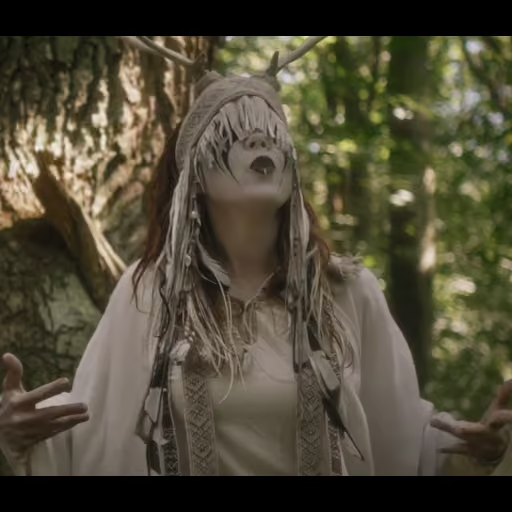
Kai Uwe Faust goes considerably further than the description you pasted.
He explains that the warriors in the video experience extreme stress during battle. Afterward, when they reach safety in the forest, they begin trembling as a way of physically releasing that experience.
He says the video depicts them using psychedelics to reach a state where these tremors can occur.
There’s an important distinction here: the video is presenting Heilung’s artistic interpretation of trauma recovery, not an established clinical treatment. Kai’s explanation about adrenaline remaining trapped in muscles shouldn’t be taken as literal medical physiology.
But symbolically, the progression from violence and terror toward safety and release makes a lot of sense. As for their claim that they recorded a ghost while using human bones and breath, I haven’t found an explanation of the precise sound or evidence of anything supernatural. I’d treat that as part of Heilung’s theatrical and spiritual storytelling unless they provide more information.
6. One more exciting detail about the album
Sagas is explicitly an interim release, not Heilung’s next conventional studio album.
According to Season of Mist, the group is entering LAVA Studios this October to begin recording its fourth full-length studio album. So the December soundtrack-related release isn’t replacing their next major album.
That’s potentially two distinct Heilung projects to look forward to.
What I find most interesting about Læknisgaldr is that its historical inspiration is plausible even without knowing the words. Medieval Germanic traditions really did contain healing incantations. There are surviving Old Norse literary references to magical healing songs and Old English healing charms, such as the Nine Herbs Charm.
The big unanswered question is whether Heilung has reconstructed or adapted a particular historical text, or composed its own modern healing incantation. Given their previous work with authentic historical sources, that’s the part I’m most curious about.