An experimental constructed language
Explore Neva
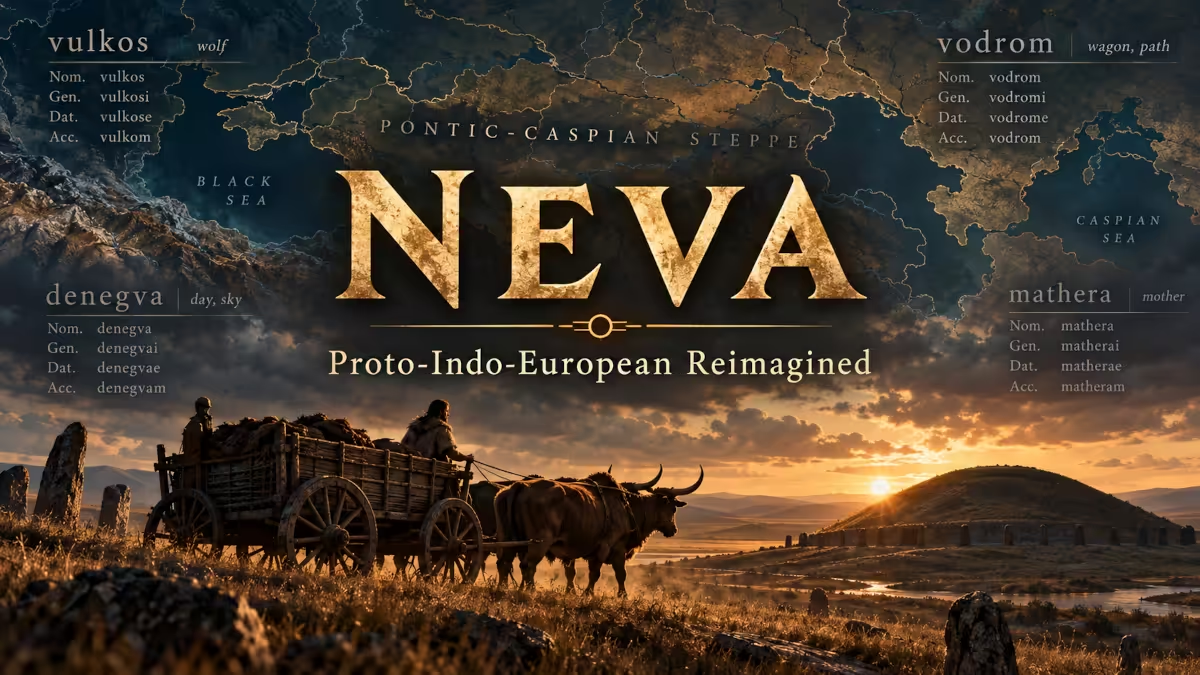
Neva imagines a modern language descended from Proto-Indo-European roots. Explore its vocabulary, grammatical forms, pronunciation, comma-separated vocabulary lookups, and an experimental English ↔ Neva translator.
You can search one word or enter comma-separated words to look them up together. Unknown terms are shown as ???.
Neva is a creative language project, not a scholarly reconstruction of Proto-Indo-European. Its evolving lexicon distinguishes historically inspired forms from invented words, and the translator currently supports only selected constructions.
Curious where the language came from?Read the story behind Neva and its Proto-Indo-European inspiration →
Search the Neva dictionary
Look up Neva headwords or their English meanings. Separate words with commas for an ordered batch lookup; unknown words appear as ???. Matches include grammar and etymological provenance.
No matching headwords. Try a shorter search or switch languages.
The language behind the tools
Neva uses a relatively regular Latin-script spelling system and retains meaningful inflections: nouns have three grammatical genders, two numbers and four cases; verbs distinguish six persons and present, past and future. Pronunciation follows a predictable pattern, including penultimate stress.
The dictionary records lexical origins and historical status so that Neva coinages aren't mistaken for attested Proto-Indo-European forms. Not all features implemented in the original Python reference translator are available in this web version yet.