Blog Essay
Heilung's 'Anoana' Explained: Bracteates, RuneS Evidence, and Runic Power-Words
A clean breakdown of Heilung's 'Anoana': which lines come from Older Futhark bracteates and early rune stones (Ågedal IK 1, the 'anoana' bracteate IK 131, Tørvika A 'ladawarijaR', Selvik IK 331 'tau liiu', and Søtvet IK 177 'aelwao'), what can be translated vs what remains formulaic/opaque, and why the song works as an incantatory collage rather than a normal prose lyric.
Introduction
Where did the inspiration and source material for Heilung’s “Anoana” come from?
This Reddit thread is mostly right about the sources (several “Maria” lines are genuinely lifted from Older Futhark objects like bracteates and an early rune stone), but it tends to oversell the certainty of translation. A Bugge-style reading of the Ågedal line is a real scholarly attempt, but large parts of bracteate text are formulaic, abbreviated, and disputed, and Heilung’s performance stitches multiple inscriptions together into something that feels like a spell—because that’s basically what these objects were used for in the first place.
So in this article I’m going to do two things at once:
- Verify what can be verified (which objects/inscriptions these phrases come from, and what the best mainstream readings look like), and
- Stop pretending we can “translate” everything—because a lot of it simply isn’t normal sentence-language.
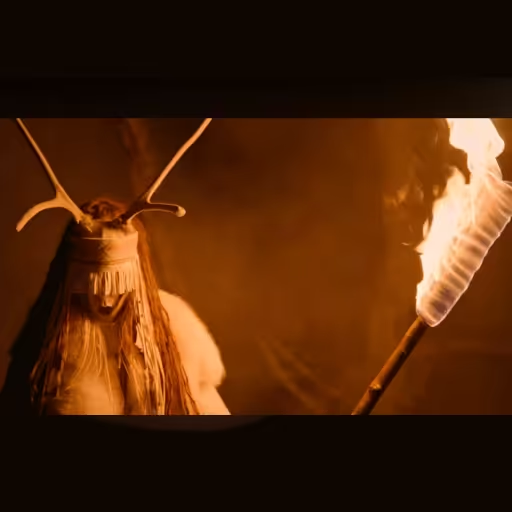
If you’re here for the philology but you haven’t actually sat with Heilung’s catalog, then check out their music videos.
::contentReference[oaicite:0]{index=0}Here’s another video that breaks down the origins of the lyrics:
1) Where the “Maria” lyrics come from (and what we can actually verify)
Most of the “Maria” refrain is real Older Futhark text lifted from specific Scandinavian Migration-Period objects. What’s not true is the idea that we can cleanly “translate the song” end-to-end like it’s a normal prose text. A lot of bracteate runic strings are formulaic, abbreviated, and disputed, and Heilung also regularizes / re-pronounces things for performance.
A. Ågedal bracteate (IK 1 / NIæR 11 / N IK1)
This is the big source for:
- aþilR rikiþiR …
- … uha …
- … elifi an it (≈ “elfi on it” in Bugge-style interpretation)
RuneS lists this object explicitly as IK 1 | NIæR11 | N IK1, findspot Ågedal, and gives inventory B3410g at the Universitetsmuseet i Bergen, and an archaeological dating window 510—590 (with discussion tying it to a richly furnished woman’s grave). (runesdb.de)
So the Reddit claim “Ågedal bracteate inv. no. 3410g” is basically right (RuneS shows B3410g). (runesdb.de)
About Sophus Bugge’s translation Bugge did publish interpretations of NIæR material; RuneS’ bibliography for IK 1 includes Bugge, Norges Indskrifter med de ældre Runer I (1891—1903) and later work. (runesdb.de) The specific English gloss you quoted (“high-born Rikithir owns… Uha engraved… elf woman…”) is a secondary paraphrase of Bugge-style readings (and the exact phrasing is modern, not Bugge’s own English). But the core idea matches a common scholarly approach to these strings: (1) a noble/title + personal name, (2) a verb of owning, (3) a maker/inscriber name, (4) a verb like ‘carved/painted/wrote’, (5) ‘on it’). (runesdb.de)
Important reality check: RuneS’ own transliteration for IK 1 is highly uncertain/fragmented in places (lots of “(1?)” style uncertainty), which is exactly why “one clean translation” is not something you can honestly “verify.” (runesdb.de)
B. “anoana” = IK 131 bracteate (IK 131 / N IK131 / NIæR 42)
RuneS has a dedicated entry for IK 131, and its transliteration is simply:
- anoana (runesdb.de)
So: the comment “the bracteate has the anoana inscription” is correct, and “anoana (not ‘ano ana’)” is also basically right as a normalized reading of the runic sequence. (runesdb.de)
RuneS also notes the findspot is treated as unknown/‘Norway(?)’ in editions (i.e., provenance uncertainty). (runesdb.de)
Meaning? There is no universally accepted lexical meaning for anoana. Treat it as a formula/word of power/name unless you have a specific edition arguing otherwise.
C. “ladawarijaR” = Tørvika A stone (N KJ91 / NIæR 20)
This one is a stone, not a bracteate. RuneS has Stein A von Tørvika (Tørvika stone A). (runesdb.de)
The key claim here is: ladawarijaR is a spelling for landawarijaR (“land-protector/land-defender”).
That specific example is explicitly discussed in an academic PDF on runic orthography: it gives ladawarijaR for landawarijaR on TØRVIKA A (KJ91/NIæR 20). (DNB Portal) So yes: that claim checks out.
But the Reddit comment says: “The language … is Old Norse.” That’s sloppy. KJ91 is an Older Futhark inscription (Proto-Nordic / early North Germanic stage), not ‘Old Norse’ in the Viking-Age sense. (People online often call everything “Old Norse”; runologists usually won’t.)
D. Søtvet bracteate (IK 177 / NIæR 8 / N IK177): “aelwao …”
RuneS lists IK 177 with transliteration (1?)l | aelwao |. (runesdb.de)
Even better: RuneS’ “interpretations” page shows one scholarly proposal reading it as lauko(z) (“leek”). (runesdb.de) That matters because “laukaz” is a well-known bracteate/amulet word in the older runic corpus (often taken as apotropaic).
So the Reddit “aelwao nl” is in the neighborhood, but RuneS’ structured data for IK177 is not literally “aelwao nl” as two clean words; it’s an uncertain sequence where editors disagree about segmentation. (runesdb.de)
E. Selvik bracteate (IK 331 / NIæR 18 / N IK331): “tau liiu”
RuneS has IK 331 and its transliteration is unambiguously:
- tau | liiu | (runesdb.de)
So: the Reddit claim “tau liiu” is verified.
Meaning? RuneS gives no translation, and that tracks mainstream scholarship: it’s not securely interpreted. (runesdb.de) The rune-name “t = Týr / a = áss / u = ūruz” acrostic-magic reading is exactly the kind of thing scholars warn about: it’s possible as later esoteric practice, but not something you can assert for a 5th—6th century inscription without additional argument.
2) So what do the “lyrics” mean?
Heilung themselves (via label/press text) frame Anoana as a collage of likely encoded spells from the Migration Period, drawn largely from gold bracteates. (Season of Mist)
That’s consistent with the data: IK 1 / IK 131 / IK 177 / IK 331 are all bracteates in the Older Futhark corpus. (runesdb.de)
A pragmatic “breakdown” of the Maria refrain
Think of it like this:
- aþilR = “noble/high-born” (a title/descriptor; commonly analyzed that way)
- rikiþiR = likely a personal name (or name-like element)
- ai(h) (often normalized to aih) = “owns”
- uha = likely the carver/inscriber’s name
- … fahd / faide … = commonly taken as a verb like “painted/inscribed” (compare the well-known early runic verb faih- “paint/inscribe,” discussed in runology; see e.g. Einang stone discussions for faihido as “painted/wrote,” though that’s a different inscription) (Wikipedia)
- … an it = “on it”
So one widely repeated interpretation (Bugge-style) is basically: “A nobleman X owns [this]. Uha carved/inscribed [something] on it.” (runesdb.de)
Then Heilung stitches in:
- ladawarijaR (Tørvika A spelling) ≈ landawarijaR “land-defender” (DNB Portal)
- anoana (IK 131) as a repeated power-word/name (runesdb.de)
- aelwao (IK 177) which may relate to laukaz (“leek”) in at least one scholarly proposal (runesdb.de)
- tau liiu (IK 331) as another formula string with no secure gloss (runesdb.de)
What about Kai’s big block of syllables?
Some of it likely comes from other bracteate inscriptions and/or performance-driven re-syllabification (“fos lau” → “foslau”, etc.), but a lot of those sequences do not have stable, dictionary-like meanings. The most honest summary is:
- Some lines are direct (or lightly adapted) runic strings
- Many are vocables/formulae whose semantics are unknown or disputed
- Heilung leans into the incantation effect more than a philological “translation”
That matches both the scholarly situation (bracteate texts are often opaque) and the band/label framing. (Season of Mist)
3) Quick verdict on the Reddit claims
- Ågedal bracteate details + NIæR 11 + IK 1: basically correct (inventory/dating/provenance supported). (runesdb.de)
- “anoana inscription = IK 131”: correct. (runesdb.de)
- Tørvika A “ladawarijaR means landawarijaR (‘land protector’)”: correct (and explicitly attested in scholarship). (DNB Portal)
- “Language is Old Norse”: misleading for KJ91-era Older Futhark material.
- Søtvet “aelwao nl”: source-object correct, but the segmentation/spelling is messier than that. (runesdb.de)
- Selvik “tau liiu” and “not interpreted”: correct; rune-name acrostic magic reading is speculative. (runesdb.de)
Full Lyrics (Anoana)
AþilR rikiþiR ai erilidi uha ifalh
("IK 1 / NIæR 11 (Ågedal): The noble/high-born RikiþiR owns [it]; Uha entrusted/inscribed [it]." — traditional Bugge-style reading; details disputed.)

Fahd tiade elifi an it
("IK 1 / NIæR 11 (Ågedal): Painted/inscribed, made/arranged: the 'elf-woman' on it." — conventional scholarly-style parsing; not 100% secure.)

AþilR rikiþiR ai ladawarijaR anoana
("Composite: IK 1 / NIæR 11 (Ågedal) + KJ 91 / NIæR 20 (Tørvika A: ladawarijaR ≈ landawarijaR 'land-defender') + IK 131 / NIæR 42 ('anoana'). Syntax is stitched/ritual rather than prose.)

Fahd tiade elifi an it
("IK 1 / NIæR 11 (Ågedal): Painted/inscribed... the 'elf-woman' on it.")

Aelwao anoana tuwatuwa
("IK 177 / NIæR 8 (Søtvet: aelwao [often discussed alongside laukaz-type amulet words]) + IK 131 / NIæR 42 ('anoana') + tuwatuwa (repeated bracteate-style formula; meaning opaque).")

Tau liiu anoana tuwatuwa
("IK 331 / NIæR 18 (Selvik: tau liiu) + IK 131 / NIæR 42 ('anoana') + tuwatuwa (formula; opaque).")

Aelwao anoana tuwatuwa
("IK 177 / NIæR 8 (Søtvet: aelwao) + IK 131 / NIæR 42 ('anoana') + tuwatuwa (formula; opaque).")

Tau liiu anoana tuwatuwa
("IK 331 / NIæR 18 (Selvik: tau liiu) + IK 131 / NIæR 42 ('anoana') + tuwatuwa (formula; opaque).")


Ul foslau lalgwu ped
("Kai section: performance/ritual vocables in a bracteate-like style; not a securely translated sentence. (No single, universally agreed IK/NIæR mapping.)")

Ul uldaul lei elw ath
("Kai section: bracteate-like formula string; opaque; best treated as incantation rather than prose.")

Ret lae tys oth rei gui
("Kai section: bracteate-like formula string; opaque; best treated as incantation rather than prose.")

Auauu la oa sejszul
("Kai section: bracteate-like formula string; opaque; best treated as incantation rather than prose.")

AualhR has ka til
("Kai section: bracteate-like formula string; opaque; best treated as incantation rather than prose.")

Az ha ir el unoz leit
("Kai section: bracteate-like formula string; opaque; best treated as incantation rather than prose.")

Una dz gui uiþuluhng
("Kai section: bracteate-like formula string; opaque; best treated as incantation rather than prose.")

Uoiwhug ditlala
("Kai section: bracteate-like formula string; opaque; best treated as incantation rather than prose.")

Lihnlal uruskglaþu
("Kai section: bracteate-like formula string; opaque; best treated as incantation rather than prose.")

Lal lalalati gþlu
("Kai section: bracteate-like formula string; opaque; best treated as incantation rather than prose.")

Til ur ur ur ur gel
("Kai section: bracteate-like formula string; opaque; best treated as incantation rather than prose.")

Þul so oth lauilatl
("Kai section: bracteate-like formula string; opaque; best treated as incantation rather than prose.")

LiRaiwui ildaituha
("Kai section: bracteate-like formula string; opaque; best treated as incantation rather than prose.")

Uþa-i u-elal
("Kai section: bracteate-like formula string; opaque; best treated as incantation rather than prose.")

Da aerui-al eiz
("Kai section: bracteate-like formula string; opaque; best treated as incantation rather than prose.")

An ra tiu an ku ak
("Kai section: bracteate-like formula string; opaque; best treated as incantation rather than prose.")


AþilR rikiþiR ai erilidi uha ifalh
("IK 1 / NIæR 11 (Ågedal): The noble/high-born RikiþiR owns [it]; Uha entrusted/inscribed [it].")

Fahd tiade elifi an it
("IK 1 / NIæR 11 (Ågedal): Painted/inscribed... the 'elf-woman' on it.")

AþilR rikiþiR ai ladawarijaR anoana
("Composite: IK 1 / NIæR 11 (Ågedal) + KJ 91 / NIæR 20 (Tørvika A: ladawarijaR ≈ landawarijaR 'land-defender') + IK 131 / NIæR 42 ('anoana').")

Fahd tiade elifi an it
("IK 1 / NIæR 11 (Ågedal): Painted/inscribed... the 'elf-woman' on it.")

Aelwao anoana tuwatuwa
("IK 177 / NIæR 8 (Søtvet: aelwao) + IK 131 / NIæR 42 ('anoana') + tuwatuwa (formula; opaque).")

Tau liiu anoana tuwatuwa
("IK 331 / NIæR 18 (Selvik: tau liiu) + IK 131 / NIæR 42 ('anoana') + tuwatuwa (formula; opaque).")

Aelwao anoana tuwatuwa
("IK 177 / NIæR 8 (Søtvet: aelwao) + IK 131 / NIæR 42 ('anoana') + tuwatuwa (formula; opaque).")

Tau liiu anoana tuwatuwa
("IK 331 / NIæR 18 (Selvik: tau liiu) + IK 131 / NIæR 42 ('anoana') + tuwatuwa (formula; opaque).")
A couple of those “translations” (especially the Ågedal lines) are best understood as a scholarly reading strategy rather than a clean dictionary translation: segmenting titles/names + an “owns” verb + an inscriber’s name + an “inscribed/painted” verb + “on it.” That’s why you’ll see Bugge-style renderings floating around, but you’ll also see modern databases mark parts of the inscription as uncertain. (LyricsTranslate)
Also: ladawarijaR → landawarijaR (“land-defender / land-protector”) is a real, explicitly attested orthography point in the runology literature (the “d” for “nd” type issue), so that particular claim is solid. (LyricsTranslate)
Conclusion
Anoana is even more “runic technology” than a normal lyric sheet. The Maria refrain is largely recognizable Older Futhark material (especially the Ågedal bracteate line and the standalone anoana string), but the overall effect is incantatory collage: named figures/titles (AþilR, rikiþiR, uha, ladawarijaR) stapled to formula words (anoana, tuwatuwa, tau liiu, etc.) and then expanded into Kai’s long torrent of bracteate-like syllable chains whose meaning is mostly “charged repetition,” not prose. That’s not a cop-out — it’s exactly how a lot of Migration-Period amuletic text behaves: compact, iterative, and only partially recoverable as ordinary language. (LyricsTranslate)